Single Qubit, Bloch Sphere, and Bloch Circle
What is a Qubit?
A classical bit contains binary information that is denoted in terms of 0 or 1 that can be used to describe a physical state. For example, a bit can describe a voltage above and below a certain threshold: 1 means a high voltage ~5V and 0 means a low voltage ~0V. Similarly in the the quantum world, states such as the polarization of photons or the spin of electrons needs a convenient representation of the smallest unit of quantum information, which we call a qubit, a short way to say "quantum bits", as an analog to classical bits.
How is a Qubit Represented?
We introduce qubit as a mathematical model that describes the smallest unit of a abstract quantum system that gives a binary outcome $\ket{0}$ and $\ket{1}$ on measurement. This is known as the bra-ket notation, bra for $\bra{\cdot}$ and ket for $\ket{\cdot}$. Since experimental data tells us that that measurement outcomes are probabilistic in the quantum realm, a single qubit state $\ket{\psi}$ (read as "psi") is involved with complex number $a$ and $b$ as its probability amplitudes. $$ \ket{\psi}=a\ket{0} + b\ket{1} \rightarrow \begin{pmatrix} a \\ b \end{pmatrix} $$ This representation, which is based on the statistical interpretation of quantum mechanics, tells us that if we measure the qubit state $\ket{\psi}$ , we have a $|a|^2$ chance of getting outcome $\ket{0}$ and a $|b|^2$ chance of getting outcome $\ket{1}$. The probability of the two possible outcomes must sum up to 1, so $$ |a^2| + |b^2| = 1. $$ This looks oddly similar to the trig identity $\sin^2(x) +\cos^2(x) =1$, so we can parameterize $\ket \psi$ into sine and cosine. Since the amplitudes are complex numbers, we need to keep a phase factor $e^{i\phi}$. $$ \ket{\psi} \rightarrow \begin{pmatrix} a \\ b \end{pmatrix}=\begin{pmatrix} \cos(\frac{\theta}{2}) \\ e^{i\phi}\sin(\frac{\theta}{2}) \end{pmatrix} $$ This means that we can parameterize a qubit in terms of polar coordinate $(\theta, \phi)$, where $0\le \theta \le \pi$ and $0\le \phi < 2 \pi$. Another useful representation of the 1-qubit state is the density matrix, which is outer product of state vectors. $$ \ket{\psi} \bra{\psi} \rightarrow \begin{pmatrix} a^* \ b^* \end{pmatrix} \begin{pmatrix} a \\ b \end{pmatrix} =\begin{pmatrix} |a|^2 & ab^* \\ a^*b & |b|^2\end{pmatrix} = \begin{pmatrix} |a|^2 & c^* \\ c & |b|^2\end{pmatrix}=\rho $$ Density matrix is useful because we can read off the probability of measurement outcomes $|a|^2$ and $|b|^2$ directly from the diagonal entries. The off diagonal entry $c$ will be useful later on as we introduce mixed states.
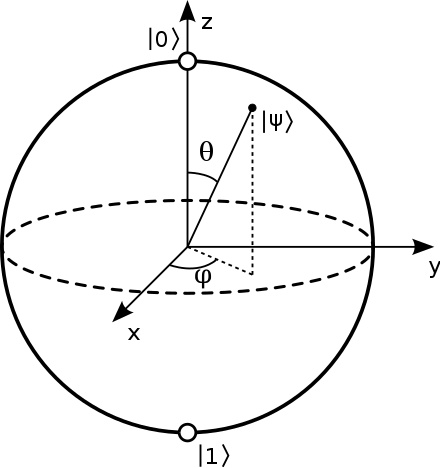
Bloch Sphere
Using polar coordinate, a qubit be represented by a unit sphere called the Bloch Sphere.
Notice that the Bloch Sphere provides a 1-to-1 mapping of a state onto a single point, and thus is a clean and convenient visual model for a single qubit state $$ \ket{\psi} \rightarrow \begin{pmatrix} a \\ b \end{pmatrix}=\begin{pmatrix} \cos(\frac{\theta}{2}) \\ e^{i\phi}\sin(\frac{\theta}{2}) \end{pmatrix}. $$ Observe that when we square the probability amplitudes the phase parameter $\phi$ has no contributions to the probability of measurement outcome: $|a|^2 = \cos^2{\theta}$ and $|b|^2 = \sin^2{\theta}$. Since the phase has no physical meaning*, it can be disregarded for the purpose of seeing the relations between state parameters and measurement outcomes. Using this observation, we take a slice of the Bloch Sphere off the phase angle $\phi$ that we call a Bloch Circle, which has nice properties that allows us to read off state properties from lengths of line segments directly:
- The red line is $|b|^2$
- The blue line is $|a|^2$
- The pink line is $b$
- The sky blue line is $a$
- The purple line is $c$
Play around with the following interactive Bloch Circle by dragging around the state point and see how $a$, $b$ and the probability of measurement outcomes changes!
In fact, the choice of measurement axis (or the standard computational basis) is free, so the parameters of a state would become different when the axis between $\ket{0}$ and $\ket{1} $ is rotated. Now try dragging around the central axis, and see how state parameters and probability of outcomes changes!
Mixed States
The above Bloch Circle plots out a pure single qubit state. Pure means that we can always rotate the measurement axis to be the diameter that goes through the statepoint, obtaining a 100% chance of a certain measurement outcome. However, a general qubit state can be a mixed state $\rho'$. Here mixing means taking a linear combination of pure states $\rho_i$, with weights $w_i$ summing up to 1. $$ \rho' = \sum_i w_i\rho_i \text{, where} \sum_iw_i =1 $$ A mixed state in general has the density matrix in the form, $$ \rho'=\begin{pmatrix} |a'|^2 & c'^* \\ c' & |b'|^2\end{pmatrix} \text{ with } |c'| \le |a'b'| $$ The fact that $|c'| \le |a'b'|$ changes how our state is plotted on the Bloch Circle. Notice that for the pure the statepoint is on the circumference. For mixed state, $|c'| \le |a'b'|$ means we have a shorter purple line and so a mixed state point is inside the Bloch Circle. We parameterize the distance a statepoint is away from the center of the Bloch Circle as $r$, which informs us the mixedness of a state. $r=\frac 1 2 $ means a pure state, $r < \frac 1 2$a mixed state, and $r=0$ a maximally mixed state.
A maximally mixed state gives 50-50 probability of measurement outcomes regardless of our choice of measurement axis. Now that we are fully equipped with knowledge about single qubits, let's move on to 2-qubits and how they can be entangled.
Summary
A qubit is a mathematical representation of the smallest unit of an abstract quantum system. A pure qubit state is represented by a state vector. $$ \ket{\psi}=a\ket{0} + b\ket{1} \rightarrow \begin{pmatrix} a \\ b \end{pmatrix} =\begin{pmatrix} \cos(\frac{\theta}{2}) \\ e^{i\phi}\sin(\frac{\theta}{2}) \end{pmatrix} $$ In general, a qubit state is represented by a density matrix, which describes mixed states. $$ \ket{\psi} \bra{\psi} \rightarrow \begin{pmatrix} a^* \ b^* \end{pmatrix} \begin{pmatrix} a \\ b \end{pmatrix} =\begin{pmatrix} |a|^2 & ab^* \\ a^*b & |b|^2\end{pmatrix} = \begin{pmatrix} |a|^2 & c^* \\ c & |b|^2\end{pmatrix}=\rho $$ A state can be represented in terms of different basis (measurement axis). We can read-off the probability amplitudes, probability of measurement outcomes and whether it is a mixed or pure state immediately from a Bloch Circle.